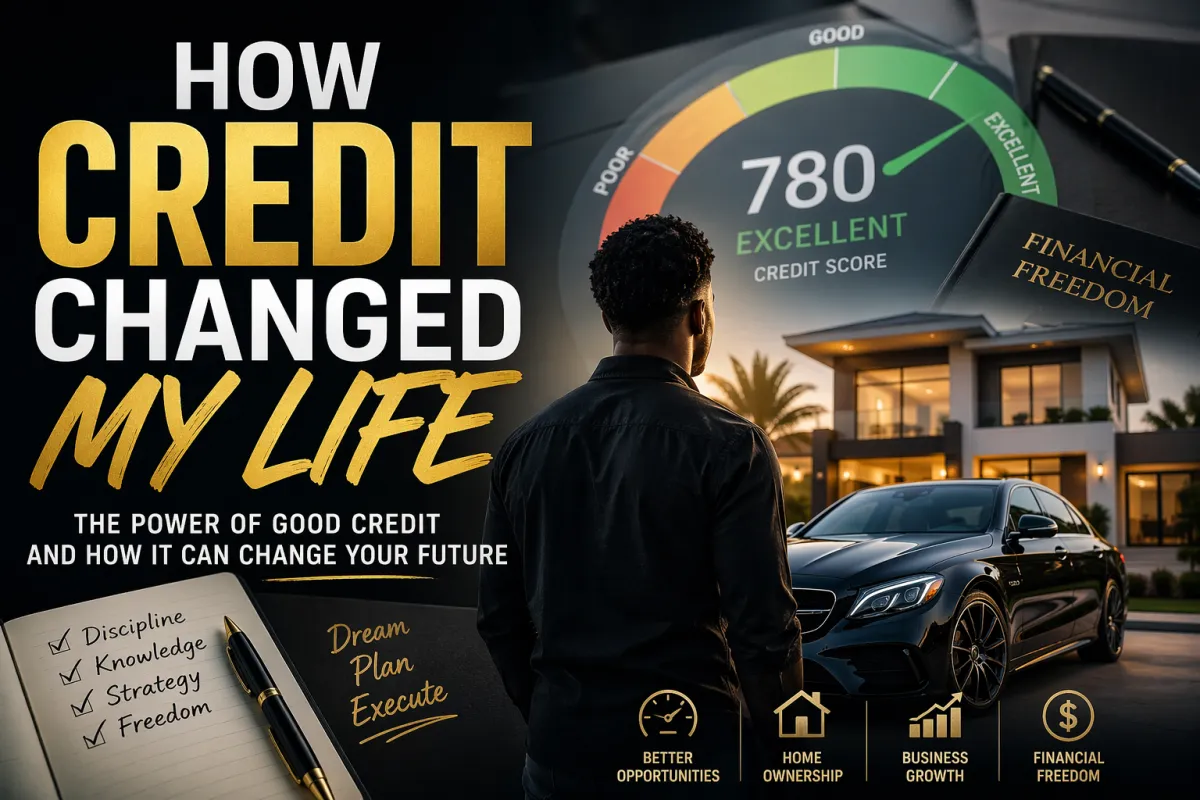
How Credit Changed My Life (And Why It Can Change Yours Too)
How Credit Changed My Life
And Why Understanding It Can Change Yours Too
For a long time, I looked at credit the way most people do: just a score.
A number.
A rating.
Something banks look at.
Something that matters only when you want to buy a car, get a credit card, or maybe qualify for a house.
But over time, I learned that credit is much more than that.
Credit is not just a score.
Credit is not just debt.
Credit is not just monthly payments.
Credit is leverage.
And once I truly understood that, my entire mindset changed.
That shift changed the way I looked at money, business, opportunities, and growth. It changed the way I moved. It changed the kind of risks I could take. It changed how quickly I could act. And most importantly, it changed what was possible for my life.
A lot of people are working hard every day, making money, trying to save, trying to build, trying to get ahead. But what many don’t realize is that hard work by itself is not always enough. You can be disciplined, motivated, and hungry — and still stay stuck if you don’t understand how money systems work.
Credit is one of those systems.
And when I started learning how it works, instead of just reacting to it, everything started to look different.
My Early Understanding of Credit Was Limited
At first, my understanding of credit was basic.
Like many people, I thought the formula was simple:
Pay your bills on time
Don’t miss payments
Keep your score decent
Avoid collections
And you should be fine
That’s what most people are told.
And while those things do matter, that’s only the surface. That’s not real strategy. That’s not how people truly use credit to create momentum.
What I didn’t understand in the beginning was that credit affects almost every part of your financial life. It can determine whether you get approved or denied. It can affect your interest rates. It can decide whether you can access capital when an opportunity shows up. It can influence how much flexibility you have when things get tight. It can even impact how fast you can grow a business or invest in assets.
That is when I started realizing:
credit is not just about staying out of trouble — it’s about positioning yourself for opportunity.
And those are two completely different mindsets.
The Real Turning Point
The turning point for me was when I stopped seeing credit as something passive and started seeing it as something strategic.
Before that, credit felt like something that happened to you.
You get approved.
You get denied.
Your score goes up.
Your score goes down.
You wait and hope things improve.
But once I started studying it deeper, I realized that credit has patterns, structure, and rules. It is a system. And like any system, once you understand the rules, you can move smarter inside of it.
I started learning things most people never take the time to understand:
What actually makes up a credit score
Why utilization matters so much
How lenders really view debt
Why age of accounts matters
How too many inquiries can hurt timing
Why one late payment can cost you much more than people think
How personal credit and business funding can connect
How profile strength matters more than just the score itself
That was a huge mindset shift.
Because a lot of people focus only on the number. They say, “What’s my score?” But sophisticated lenders and smart borrowers know something deeper:
A score alone does not tell the whole story.
You can have a decent score and still have a weak file.
You can have a good score and still get denied.
You can have money coming in and still not have the profile lenders want to see.
That is when I started realizing that building credit is really about building a reputation on paper.
It is your financial identity.
It tells lenders how you manage obligations.
It tells them whether you are risky, stable, careless, or disciplined.
It tells them whether you are prepared.
And once I understood that, I stopped thinking short term.
Credit Gave Me Something Bigger Than Money: Options
This is the biggest lesson I learned:
Good credit gives you options.
And options change your life.
When you don’t have options, every decision feels heavy. Every emergency feels bigger. Every opportunity feels harder to reach. You become reactive. You take what you can get. You accept high rates, bad terms, bad timing, and bad deals because you do not have enough financial flexibility.
But when your credit improves and your profile becomes stronger, things start opening up.
Now you have choices.
You can compare lenders.
You can negotiate better terms.
You can move quickly when a deal comes up.
You can preserve your cash instead of draining it.
You can separate short-term pressure from long-term strategy.
That is powerful.
Because money alone is not always the answer. Plenty of people make money and still stay financially trapped because they never build leverage. They earn, spend, reset, and repeat.
Credit, when used correctly, helps you break that cycle.
It gives you access before you desperately need it.
It gives you room to operate.
It gives you the ability to move faster than waiting on cash alone.
That changed the way I looked at everything.
How Credit Changed the Way I View Opportunity
One of the biggest changes credit made in my life was how I respond to opportunity.
Before, if something came up, the first question was often:
“Do I have the cash for this right now?”
And if the answer was no, the opportunity might pass.
But strong credit changes that conversation.
Now the question becomes:
“Is this a smart opportunity, and how do I structure it properly?”
That is a completely different level of thinking.
Because in business and investing, timing matters.
Sometimes the best opportunity is not waiting for you to save money for six months or a year. Sometimes the right move has to happen now. Sometimes speed matters just as much as the deal itself. Sometimes access matters more than income in that moment.
And that is where credit becomes a tool.
Not to be reckless.
Not to live beyond your means.
Not to buy things you cannot afford.
But to move intelligently.
To use leverage where it makes sense.
To keep cash available.
To create flexibility.
To build without always being forced to wait.
That shift is massive, especially for anyone trying to grow in real estate, entrepreneurship, or investing.
How Credit Impacts Real Estate
In real estate, credit can change your life fast.
It affects what you qualify for.
It affects your monthly payment.
It affects your down payment options.
It affects your rate.
It affects whether you can close when the opportunity shows up.
And in real estate, small differences on paper can create huge differences in real life.
A slightly better rate can save you thousands.
A stronger profile can unlock a better loan product.
A cleaner file can make an underwriter more comfortable.
A better credit position can help you act faster than someone else.
That matters.
Because real estate is not just about finding the right property. It is also about being in a position to execute.
A lot of people think they are not ready to buy because they are only looking at income or savings. But often the real issue is that their credit profile is weak, thin, damaged, or mismanaged. And because of that, doors stay closed that could have opened with the right preparation.
Learning credit helped me see that financing is not random. It is strategic.
And once you understand that, you stop looking at approvals as luck. You start looking at them as something you can prepare for.
How Credit Changes Business Growth
Credit can also completely change the way you build a business.
A lot of business owners start by bootstrapping everything. They use only the money they currently have. And while there is nothing wrong with being careful, there comes a point where only relying on cash can slow your growth.
Sometimes you need capital for:
marketing
payroll
operations
equipment
expansion
deal flow
short-term liquidity
unexpected expenses
If you do not have strong credit, those moments become stressful. Your choices become limited. You may take bad money, expensive money, or no money at all.
But when your credit is strong, you position yourself differently.
You are not begging for options.
You are evaluating options.
That is a completely different place to operate from.
And that is one reason credit changed my life. It showed me that financial strength is not only about how much cash you have today. It is also about how well positioned you are to access capital when needed.
That matters in every serious business.
The Emotional Side of Credit No One Talks About
Most people only talk about credit in technical terms. Scores. Accounts. Utilization. Inquiries. Limits.
But there is also an emotional side to this.
Bad credit creates stress.
It makes you feel behind.
It makes you feel judged.
It makes things more expensive.
It makes emergencies feel heavier.
It makes you feel like you are always trying to catch up.
A lot of people carry shame around credit. They feel embarrassed about mistakes they made when they were younger. They feel frustrated by denials. They feel defeated after trying and getting rejected.
I understand that.
And part of what changed my life was not just improving credit itself — it was changing my relationship with it.
I stopped looking at it emotionally.
I stopped seeing it as a label.
I stopped treating it like a punishment.
I started treating it like data.
Like a system.
Like a tool I could learn.
That made a big difference.
Because once you remove shame and replace it with strategy, you get your power back.
You stop saying, “I’m bad with credit.”
And you start saying, “I need a better structure.”
That mindset change is everything.
What Most People Get Wrong About Credit
A lot of people hurt themselves without realizing it.
They think using credit means maxing out cards.
They think paying minimums forever is normal.
They apply for too many things too quickly.
They close old accounts without understanding the impact.
They ignore late payments.
They only care when they need funding right away.
That is backwards.
The best time to build credit is before you need it.
Because once you need money urgently, the pressure goes up and the mistakes get more expensive. You are no longer building from strength. You are trying to solve a problem under pressure. That often leads people into bad terms, high rates, and rushed decisions.
Strong credit rewards preparation.
That is why I believe everybody should work on their credit before the emergency, before the deal, before the investment, before the lender meeting, before the application.
Because when the time comes, the profile you built earlier is what gives you leverage.
Credit Taught Me Discipline
Another reason credit changed my life is because it forced me to become more disciplined.
Credit does not just reflect money. It reflects behavior.
It shows:
how consistent you are
how patient you are
how organized you are
how you handle pressure
whether you think short term or long term
That is why building credit the right way can shape your overall financial habits too.
You start paying attention more.
You start planning better.
You start watching timing.
You start respecting structure.
You start understanding that one careless move can create long-term consequences.
And on the positive side, one smart move repeated consistently can open major doors later.
That is a powerful lesson beyond just credit.
It is a life lesson.
The Truth: Credit Alone Won’t Save You — But It Can Accelerate You
I also want to be clear about something important:
Credit is powerful, but it is not magic.
It will not fix bad decisions.
It will not replace discipline.
It will not turn a bad investment into a good one.
It will not solve a spending problem.
It will not create wealth by itself.
But it can absolutely accelerate a disciplined person.
That is the difference.
If you have vision, work ethic, and strategy, credit can help you move faster. It can help you preserve liquidity. It can help you unlock better opportunities. It can help you build with more flexibility.
But if someone uses credit emotionally, recklessly, or without a plan, it can also trap them.
That is why the goal is not just to “have credit.”
The goal is to understand it.
Respect it.
And use it intentionally.
Questions You Should Ask Yourself
If you really want to know whether your credit is helping your life or hurting it, ask yourself:
If an opportunity came up today, could I access capital?
If I applied for financing right now, would I feel confident?
Am I using credit strategically or just reacting to bills?
Do I know what is helping my profile and what is hurting it?
Am I building a financial reputation, or ignoring it?
Is my credit creating freedom, or creating pressure?
Those questions matter.
Because credit is not just about approval. It is about readiness.
What I Believe Now
Today, I see credit very differently.
I see it as a foundation.
A tool.
A form of leverage.
A financial weapon when used correctly.
A doorway to bigger moves.
A system that rewards discipline and punishes carelessness.
Most importantly, I see it as something people should learn early.
Because the sooner you understand credit, the sooner you stop moving blind. The sooner you start making decisions with intention. The sooner you stop paying unnecessary costs. The sooner you start positioning yourself for better outcomes.
That is why I say credit changed my life.
Not because it magically made everything easy.
But because it changed the way I think.
It changed the way I prepare.
It changed the way I access opportunity.
It changed the level of control I have over financial decisions.
And control matters.
Options matter.
Speed matters.
Positioning matters.
Final Thought
A lot of people spend years trying to make more money, but they never take the time to strengthen the systems that allow money to work better for them.
Credit is one of those systems.
When you understand it, you stop living financially reactive.
You stop waiting for permission.
You stop missing opportunities because you are not prepared.
You start building leverage.
You start moving smarter.
You start creating options.
And that can change everything.
Credit changed my life because it gave me access, flexibility, and a different way of thinking.
And for anyone serious about growth — in life, business, or real estate — that matters more than most people realize.
If your credit needs work, do not ignore it.
If your profile is weak, do not wait until the last minute.
If you want to put yourself in a better position financially, start now.
Because the goal is not just a higher score.
The real goal is:
more options, better opportunities, and stronger financial control.
Learn More & Go Deeper
If you’re serious about fixing, building, or mastering your credit the right way, I broke everything down step-by-step in my guide:
👉 Zaza eBook Personal Credit Mastery
This isn’t theory — it’s practical, real-world strategy you can actually use to:
Build your profile the right way
Avoid costly mistakes
Position yourself for approvals and funding
Understand how lenders actually think
If you want to stop guessing and start moving with a plan, this will help you get there.
📘 Get it here: https://zazaliving.net/zaza-ebook-personal-credit-mastery


