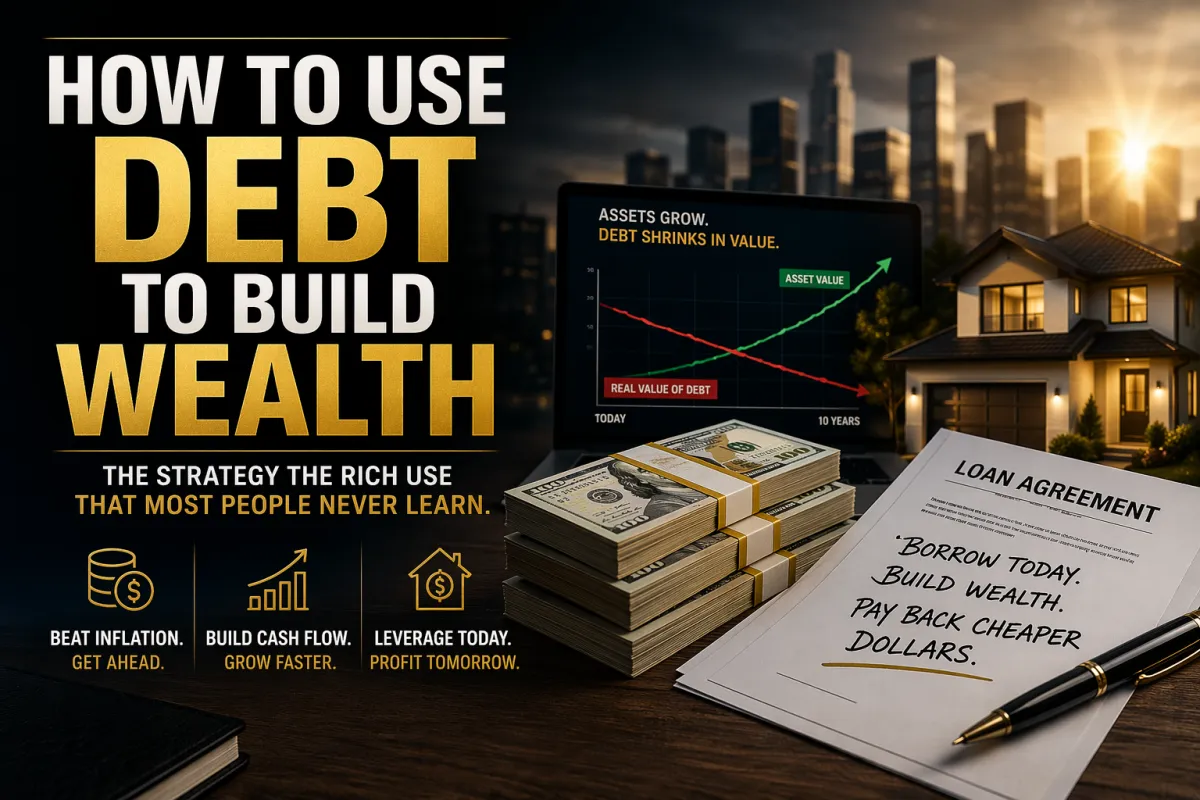
how to use debt to build wealth
How Debt Really Works: The Wealth Strategy Most People Never Learn
There are two types of people in the financial system:
Those who use debt to build wealth
Those who use debt to survive
Most people fall into the second category—and that’s why they stay stuck.
They’ve been conditioned to believe:
Debt is dangerous
Borrowing is irresponsible
Being “debt-free” is the ultimate goal
But if you study how money actually works at the highest level, you’ll see something different:
Debt is not the enemy. Misused debt is.
And when used correctly, debt becomes one of the most powerful tools to accelerate wealth.
The System You’re Playing In (Whether You Realize It or Not)
We don’t live in a “cash-based” economy.
We live in a debt-based system.
Banks create money by lending
Governments operate on deficits
Corporations grow through leverage
Real estate markets depend on financing
This means one thing:
Access to capital matters more than having capital.
If you understand how to access and deploy money—even if it’s not yours—you can move faster than 95% of people.
The Biggest Lie: “Save First, Then Invest”
This is the slowest path possible.
Let’s break it down logically.
Saving Approach:
Save $2,000/month
After 5 years = $120,000
By that time:
Prices have increased
Opportunities have passed
Inflation has eaten your buying power
Now compare that to leverage.
The Leverage Approach: Compress Time
Instead of waiting years:
You borrow $120,000 today
You invest immediately
You start generating returns NOW
You just compressed 5+ years into today.
That’s the real power of debt:
It collapses time.
The Math Behind It (Simple but Powerful)
Let’s say you borrow $200,000 at 8%.
Annual cost:
→ $16,000
Now you invest it into something producing 15% return:
→ $30,000/year
Your net:
→ $14,000 profit
That’s the spread.
Now layer on:
Rent increases
Property appreciation
Tax benefits
Inflation reducing your debt
You’re not just making $14K—you’re stacking multiple advantages.
Why Inflation Makes Debt Even More Powerful
Inflation is the most misunderstood concept in wealth building.
It works like this:
The cost of everything rises
The value of money drops
Now think about your debt.
If your loan is fixed:
Your payment stays the same
But:
Your income rises
Your asset value rises
So over time:
Your debt becomes easier and easier to pay.
Real Example (Long-Term View)
You take a $300,000 loan today.
Payment: fixed
Rate: fixed
10 years later:
Property value: $500K+
Rent: significantly higher
Your income: higher
But your loan?
→ Still based on old dollars
That’s why long-term fixed debt is powerful.
The Wealth Formula (Simple but Most Ignore It)
Borrow at X → Invest at Y → Keep the difference
Where:
X = cost of capital (interest rate)
Y = return on investment
As long as:
→ Y > X
You win.
Where People Go Wrong
Debt is dangerous only when:
1. No Cash Flow Plan
They borrow money without knowing how it will be repaid.
2. Emotional Spending
They use debt for lifestyle instead of assets.
3. No Margin for Error
No reserves, no backup plan.
4. Overestimating Returns
Bad deals kill good strategies.
Types of Debt (You Need to Understand This Clearly)
1. Consumer Debt (Avoid)
Credit cards for shopping
Luxury cars
Vacations
This:
→ Produces ZERO return
→ Only drains you
2. Productive Debt (Use This)
Real estate loans
Business funding
Marketing capital
Asset-backed investments
This:
→ Produces income
→ Builds wealth
Real Estate: The Perfect Debt Vehicle
Real estate is one of the best ways to use debt because it gives you:
1. Leverage
Control large assets with small capital.
2. Cash Flow
Tenants pay you monthly.
3. Appreciation
Property increases in value.
4. Tax Benefits
Depreciation, write-offs.
5. Inflation Hedge
Rents go up with inflation.
Advanced Strategy: Infinite Banking & Recycling Capital
Wealthy individuals don’t just borrow once.
They:
Borrow
Invest
Generate cash flow
Refinance or pull equity
Repeat
This creates a loop:
Capital → Asset → Income → More Capital → More Assets
This is how portfolios grow fast.
Advanced Strategy: Other People’s Money (OPM)
The highest level isn’t even your own debt.
It’s combining:
Bank money
Investor money
Creative financing
Example:
Investor brings capital
Bank provides leverage
You control the deal
Now you’re scaling without using your own cash.
Risk Management (What Actually Matters)
Smart investors focus more on risk control than returns.
You need:
Reserves (3–6 months minimum)
Conservative projections
Multiple exit strategies
Strong deal analysis
Because:
The deal matters more than the debt.
The Psychological Shift
This is where most people fail.
They think:
“Debt = stress”
But wealthy people think:
“Debt = opportunity”
The difference is:
→ Knowledge and control
The Real Goal
The goal is NOT:
To be debt-free
The goal IS:
To have assets that produce enough income to:
Cover your debts
Cover your lifestyle
And still leave profit
The End Game: Financial Freedom Through Leverage
When done right, you reach a point where:
Your assets pay all your expenses
Your debt is covered automatically
Your net worth grows continuously
At that point:
You’re no longer working for money.
Money is working for you.
Final Truth
Debt is a tool.
In the hands of someone uneducated:
→ It destroys
In the hands of someone strategic:
→ It multiplies wealth
The One Question That Changes Everything
Before taking any loan, ask:
“Will this money help me control an asset that pays me?”
If yes → move forward strategically
If no → don’t touch it.


